


The Atlas hits 100
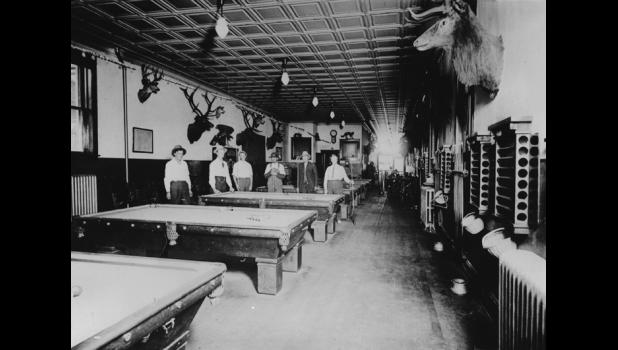
It’s been a century since masons finished assembling the locally quarried sandstone blocks, workers installed a Brunswick-Balke-Collender mahogany front and back bar beneath a pressed-tin ceiling, and the Atlas Bar and the Atlas Pool Hall opened for business.
A destination stop for tourists passing through Stillwater County, the New Atlas Bar will celebrate its 100th anniversary on Saturday, March 26.
The New Atlas Bar “unquestionably possesses one of the most intact historic bar interiors in Montana,” State Historic Preservation Officer Jon Axline said in his March 2011 filing to place the site on the National Register of Historic Places.
But many tourists also come to see the infamous “Dead Animal Zoo.” Among the 60-some animal mounts on the bar’s walls or inside wood-and-glass cases, each with its own story, are an albino fawn shot by a feuding landowner when mistaken for a goat; a wolf roped by Minnie Driver in the 1920s – reportedly the last wolf killed in Stillwater County; the head of a bison bagged on an island in Great Salt Lake; an elk with a deformed horn shot with a pistol by Nelson Miller on Huntley Flat outside Columbus; and a two-headed calf that reportedly lived for three weeks in 1961.
Historic register
The Atlas Block, comprising two lots on Pike Avenue, is one of 11 sites in Stillwater County on the National Register of Historic Places.
Other sites include the Hovda House and the Sandstone and Cobblestone school buildings in Absarokee; the 4K Ranch in Dean; the Torgrimson Place in Fishtail; the Stoltz House and the United Methodist Episcopal Church in Park City; and the Halfway House, Jacobs House, Norton House and Mountain View Cemetery in and around Columbus.
Built of sandstone blocks from the same quarry that provided rock for the Montana State Capitol in 1900, the 50-foot wide Atlas Block consists of two sections, each two stories high with a full basement.
The building’s original owners – Michael Jacobs, who owned the Montana Sandstone Company, and Thomas Mulvihill, a saloon owner – hired Billings architect Curtis Oehme to design the building.
The east section was completed first and was initially used by the Columbus Mercantile Company. By December 1915, fraternal, civic and religious organizations held meetings on the second floor.
The Rebekahs, Odd Fellows and Masons were present in January 1916 when an overheated chimney ignited a floor joist in the basement. The club members were able to extinguish the fire, and visitors to the New Atlas Bar basement can still see the burned timber.
Jacobs and Mulvihill intended to complete the west section and get the Atlas Bar open in time for St. Patty’s Day in 1916, but fixtures and furnishings failed to arrive on time. The grand opening was delayed to noon on March 27. More than 300 people attended, with half staying for a free meal that evening.
Stylish saloon
The Atlas Bar offered customers a smoking room and cigar stand near the Pike Avenue entrance; a billiard room with six tables and state-of-the-art lighting; a narrow bar room with no tables or chairs; a three-lane bowling alley in the basement using smaller, nonstandard balls and pins; and a lunch room, also in the basement.
The bar area “will be a no loafing place, and those who want to rest will have to find accommodations in the billiards room,” the Columbus News reported at the time. The owners figured that eliminating chairs in the bar would mean “that the greater part of the noise and rowdyism that usually permeates the bar room will be eliminated,” the newspaper reported. The 18-inch thick stone wall between the east and west sections would also help deaden the noise for the mercantile customers, Jacobs and Mulvihill said.
A ladies sitting room, with its own entrance on Pike Avenue and a bell or buzzer system for ordering drinks, is now the New Atlas Bar’s gaming room. Minors, including newspaper boys, were not allowed inside the establishment.
The owners were forced to rethink their business model during the 1920-1933 Prohibition Era, turning to sporting goods, soft drinks and ice cream among other ideas. Jacobs died in 1927, and Mulvihill continued to run the establishment as a saloon after 1933, incorporating the place as the New Atlas Club in March 1949.
Margaret Miller sold the east section of the building to Mulvihill in 1956, uniting the entire building for the first time under one ownership. Mulvihill died three years later and his son, Thomas P. “TP” Mulvihill, ran the bar until he retired in the 1980s. TP’s daughter Lavelle owned and operated the bar until 1997, when she sold it to Mickey Barrett and her two children, Lars Swanson and Dana Burchell.
Legend has it that the New Atlas Bar has the oldest liquor license in the state. The Montana Department of Revenue can’t confirm the legend – their records only go back to 1947. Prohibition was repealed in March 1933, at which time every bar in the state applied for a state liquor license. Prior to Prohibition’s start in 1919, Montana’s saloons were not required to have liquor licenses, according to Mary Ann Dunwell at the Department of Revenue.
Celebration on tap
Shawn and Gena Pluid are now positioning themselves to take over ownership of the historic saloon. Shawn grew up in Belgrade and spent 12 years in the Army. Gena grew up in the Columbus area (her maiden name is Rasmussen). They met in Bozeman, where he worked as a cook and she was a bartender.
A celebration marking the 100th year of the New Atlas Bar will be held on Saturday, March 26, with an acoustic bluegrass band playing at 2 p.m. and pulled pork sandwiches available. The sandwiches are a preview of a new barbecue restaurant opening soon next door to be called the Dead Zoo Q, Swanson said.
Donations will be accepted to pay for the celebration and to go to the Museum of the Beartooths. Beer glasses with a special New Atlas Bar logo will be available for sale, with the proceeds going to the museum.
Tim Urbaniak, of the Montana Historic Preservation Review Board, will present a program on the history of the New Atlas Bar at the bar at 1 p.m. Swanson and Museum of the Beartooths Director Penny Redli will lead a tour of the building immediately following the program.