
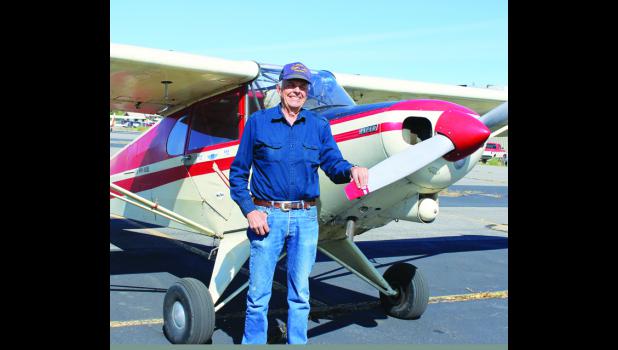
Airport Authority plans beginning to take flight
agree about the importance of the Woltermann Memorial Airport to area residents, but questions exist over how to manage the facility and pay for day-to-day operations, maintenance and future improvement projects.
The Joint City-County Airport Board has proposed setting up an airport authority to take over airport management duties, including handling lot leases for hangars. A resolution to create the airport authority is currently under review by both the town and county attorneys.
The four-page resolution calls for establishing an Airport Authority Board of Commissioners to oversee the new management entity and using a 2-mill countywide levy to pay for it. Accompanying the resolution is a set of bylaws for the new board, which calls for the town or the county to provide a secretary, and a very preliminary draft budget totaling $64,000.
Two mills will raise about $80,000, based on this year’s tax valuation, Stillwater County Commissioner Gerald Dell said. He said he’s concerned that the mill levy will shift the tax burden for the airport from town residents to county residents instead of sharing costs 50/50.
Currently, the town and the county each provide $5,000 per year for airport maintenance. That works out to about $2.51 per town resident and 68 cents per county resident outside the Columbus city limits. The same amount of money spread evenly among all residents in Stillwater County would come to $1.07, which amounts to a 57 percent increase for out-of-town residents.
According to Finance Officer Joe Morse, the county currently takes care of running Airport Board meetings, paying and tracking bills and leases, and handling audits as necessary.
Commissioner Maureen Davey commented on the airport during an Aug. 18 meeting, saying it’s much improved and more efficient since joint town-county management was established.
“Now we just need to figure out how to pay for this management,” she said.
Commissioner Dennis Shupak said a future repaving project is estimated to cost $1.5 million. The Federal Aviation Administration will pay for 90 percent, leaving the rest to be split 50/50 between the town and county.
“That’s $75,000 each – a significant amount of money,” Davey said.
Past capital projects shared between the town and the county have included installing an animal control fence around the airport and purchasing a snowplow and storage shed.
Dell said he wants to see any mill levy proposal go to the voters, a point that was shared by town councilors Paul Edwards, Jon Brown and Terry Nystul. The three councilors also agreed about the importance of the airport and the need to maintain a 50/50 cost share between town and county. They also supported the proposed paving project.
“If we’re going to have an airport, let’s have a decent one and pay what’s needed,” Edwards said.
Brown said the airport has been seeing more use, particularly with the Stillwater Mining Company and recent growth.
“We need sufficient funding to do what we need to do to keep the airport in good shape,” he said.
Nystul said the airport is a definite asset for the town and the county, and an airport authority would provide a good way to share costs equitably.
“Let’s not let what we have deteriorate,” he said. “We have good FAA funding. Let’s preserve what’s in place.”
Hardin Graham, the unofficial airport manager, runs an aviation maintenance and repair business at the airport. He said regular maintenance of the airport is currently done entirely by volunteers, including mowing, fixing lights and plowing snow in the winter.
“An airport authority is a great idea,” he said. “Every airport should be run that way.”
Graham didn’t think the manager job under an airport authority would be full-time, but he’d be glad to take the job.
“I haven’t been paid for five or six years,” he said.
Putting the airport under a single board would streamline management and put aviation people in charge.
“Right now, the airport’s co-owned, and city and county policies don’t always meld,” he said. “That’s no one’s fault – it’s just the way it is.”
Graham said there’s fear among politicians that “once they give away authority to an airport authority, it will be abused.”
“That’s human nature,” he said.
Graham said regular airport maintenance would not cost $80,000 per year, but what’s left each year could be banked for future projects.
“Two hundred thousand in the bank will get you $2 million from the FAA,” he said.
Airport capital plan tops $2.8 million
A seven-year capital improvement plan for the Woltermann Memorial Airport in Columbus calls for repaving the runway and taxilanes, rehabilitating runway lighting, acquiring more land for hangar space, adding more taxilanes for the new hangars, preserving the new runway paving, and preparing documents to acquire more land to lengthen the runway.
According to the document addressed to Wade Cebulski, at the Montana Department of Transportation’s Aeronautic Division, the total cost of the seven-year plan is $2.8 million from the Federal Aviation Administration and $288,843 from local sources.
The plan was drafted by Morrison-Maierle engineering consultants under a contract jointly paid for by Stillwater County and the town of Columbus.
The Columbus Town Council signed off on the plan on Sept. 8, and the Stillwater County Commissioners approved it on Sept. 15.
Under the current airport management agreement, local costs would be equally shared by the county and the town. The plan’s timeline includes:
•A contract for design work for the runway and taxilane repaving project has already been approved and budgeted for locally. Under the capital plan, the repaving project would take place in 2017, with the FAA paying $1.8 million and the county and town sharing $188,544.
•The capital plan also calls for rehabilitating the airport’s runway lighting in 2018, as the equipment is nearing its typical 20-year design life. The cost is estimated at $282,870 for the FAA and $31,340 for the county and town.
•Work in 2019 on an environmental assessment for the acquisition of land for more hangar space is estimated to cost $90,000 for the FAA and $10,000 for the county and town. The existing hangar area is nearing build-out, the plan states, with room for only 14 T-hangars, where aircraft share a building, or seven box hangars.
•The preferred alternative in the plan is to acquire two to three acres to the east of the current hangar space to create the potential for 15 more T-hangars and seven box hangars. The plan calls for acquiring that land in 2020 at a cost of $65,700 for the FAA and $7,300 for the county and town.
•The plan calls for design work and construction of taxilanes for the new hangar area in 2021, along with rehabilitating the repaving work completed in 2017, including seal coating to prevent cracking. The estimated cost for the two items is $314,115 for the FAA and $34,902 for the county and town.
•Work in 2022 on an environmental assessment for the acquisition of additional land east of the airport so the runway can be extended is estimated to cost $150,000 for the FAA and $16,667 for the county and town. According to the plan, the current 3,800-foot-long runway can only accommodate 75 percent of small aircraft with less than 10 passengers, under current FAA guidelines. The goal of the plan is to accommodate up to 100 percent of those aircraft.
Hardin Graham, who operates an aviation maintenance and repair business at the airport and is the unofficial airport manager, says the seven-year plan “is just a plan – it’s not written in stone.”
He said the FAA requires that a capital improvement plan be in place before it provides funding for the runway repaving project. As for adding hangar space, “As long as there is growth potential, we need to plan for it,” he said. The additional lease space is also a source of revenue for the airport, he said.