
River in crisis
Columbus river guide Chris Fleck called it “the perfect storm.”
A combination of record low flows on the Yellowstone River, high temperatures, congregating fish and the emergence of a deadly microscopic parasite that has led to the death of thousands of fish during a two-week period.
Last Friday the situation reached a boiling point with Montana Fish, Wildlife and Parks making the unprecedented move of closing the Yellowstone River and its tributaries to all recreational activities. The closure encompasses 183 miles from Gardiner to the Highway 212 bridge at Laurel, as well as the Stillwater River, said FWP’S Andrea Jones.
Of that, 100 miles is being heavily affected.
To date, more than 4,000 whitefish and some trout have been found dead and FWP estimated that number will rise to the tens of thousands.
Jones said Wednesday afternoon that one cutthroat trout has also tested postitive for the parasite.
Mortality in the most affected part of the river near Livingstonhad not dropped off as of Wednesday.
Late last Friday, in an 8-mile section of the river, 895 dead whitefish were found. And that was on just one side of the river.
Biologists continue to sample sections of the river outside the closed area to check on conditions. Water quality samples.
“Testing takes time, two days,” Jones said, noting that officials are assessing and evaluating the situation constantly.
When the numbers of dead fish start going down, it will be a sign that things are improving.
While the parasite is not harmful to humans or other animals, FWP did issue a notice Tuesday recommending that people get pets away from fish carcasses as other bacteria associated with decomposing fish could be present.
The parasite was identified late last week by biologists. It causes Proliferative Kidney Disease, which carries a mortality rate of 20 percent to 100 percent. It has been documented in Montana just twice in past two decades, with recent outbreaks in Washington, Oregon and Idaho, according to FWP.
LOCAL IMPACT
Fleck, owner of the Stillwater Angler and a guide since 2003, said the impact on his business was immediate. One guided float trip was postponed and Fleck was looking at the Yellowstone below Laurel as well as a Wyoming river as possible locations for upcoming trips.
The retail end of his business was at zero, forcing him to cut back the fly shop hours and lay-off his part-time worker.
“I’m not panicking, just cutting back and making some adjustments,” said Fleck.
He has 20 trips still booked.
“We’re not just closing our doors and sitting on our hands,” said Fleck.
Fleck also said he was glad this happened in late August instead of late June.
Fleck has been a guide since 2003 and has never seen anything like this before.
But he agrees with the state’s decision on the closures.
“We are all concerned about the long-term health of the fishery,” said Fleck.
He also called the conditions that apparently produced the fish kill the “perfect storm” of low flows, high water temperatures and fish congregating.
He also said he has hope for the fishery.
“These are hardy fish. These are wild fish, not hatchery fish,” said Fleck, adding that a bit of Mother Nature’s natural selection may be at play as well.
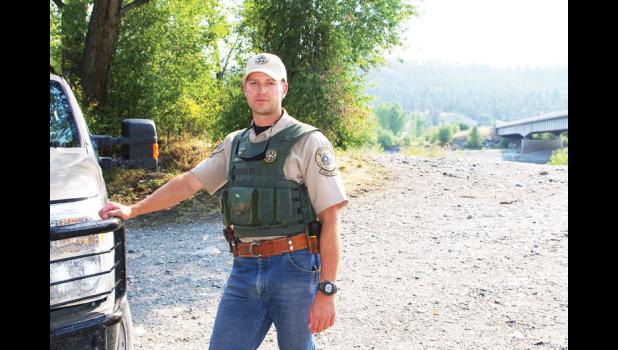
Late Monday afternoon, FWP Game Warden Paul Luepke stopped at Itch-Kep-Pe Park in Columbus to survey the river. Luepke had spent most of the previous days patrolling the Yellowstone and Stillwater making sure no one was violating the closure of the waterways. Luepke said he had come across a few fisherman who were unaware of the closure. He was getting a lot of phone calls and a lot of flag-downs.
As of Monday afternoon, Luepke said he had not seen any fish kill.