
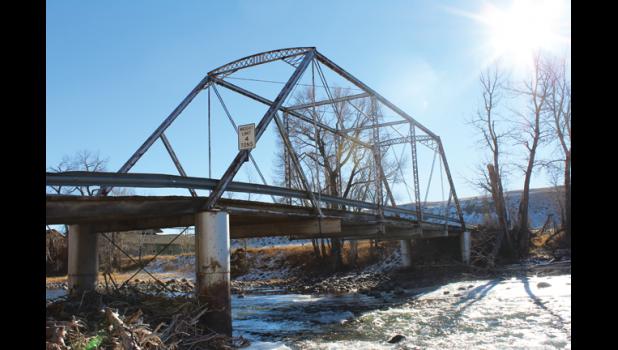
Historic bridge replacement draws asthetic concerns
Concerns about saving an historic bridge while dealing with narrow rights-of-way drew more than 30 people to a meeting about replacing the Johnson Bridge on Dec. 3.
A possible solution is a pony truss bridge that is more aesthetically pleasing than a pre-stressed concrete beam bridge and would more easily fit within the existing rights-of-way, Jeff Olsen, a project design engineer at Montana Department of Transportation’s Billings District office, told community members at the Cobblestone School in Absarokee.
“The practical reality is that we can’t get a concrete bridge to fit here, and I wouldn’t want to do that to you,” Olsen said.
Stillwater County owns the bridge and is responsible for its maintenance. The county commissioners turned to MDT for help in both funding and design work to replace the single-lane bridge over the Stillwater River about two miles northwest of Absarokee. All three commissioners attended the meeting.
The 163-foot long truss bridge was built in 1907 and currently has a 4-ton load limit – about the same weight as a pickup truck.
That rules out livestock trailers, large farm equipment, ambulances, fire trucks – and the road graders and gravel trucks needed to maintain county roads north of the bridge, Stillwater County Road & Bridge Superintendent Mark Schreiner said.
Alternative routes are a good distance away. The Spring Creek Road Bridge, a 30-year-old Glulam bridge about 4.5 miles upstream, has been proposed for replacement on a 50/50 basis between the state and the county. The Miller Road Bridge, about 6 miles downstream, is a newer concrete bridge built by MDT.
Olsen said the Johnson Bridge replacement project has been under consideration for a long time. A field study was conducted about 15 years ago and again in October 2014. MDT inspects the bridge every two years, in accordance with federal law.
Olsen said he likes truss-type bridges but they are “fracture critical.”
“If one member is damaged, the whole bridge is compromised,” he said.
A vertical member on the Johnson Bridge was spliced after a vehicle hit it. But there are other problems, Olsen said – the century-old steel may have weakened over the years, the wooden timbers supporting the short spans at each end of the bridge may be rotten, and there is likely a lot of rusting steel hidden from view.
As for reinforcing the historic bridge rather than replacing it, “My guess is it wouldn’t be economical, in my professional opinion,” Olsen said.
Confining the rights-of-way are large cottonwood trees, a house and an irrigation ditch head gate on the north side of the bridge. Both the head gate and the Johnson Bridge are eligible for listing on the National Register of Historic Places, Olsen said.
Further complicating the project are a box culvert crossing for the irrigation ditch about 100 feet north of the Johnson Bridge and concerns by a landowner on the south side of the bridge about a wider county road eating away the property she and her husband saved for decades to buy.
Reducing the width of the new bridge from the 28-foot state standard to 20 feet could possibly address those two problems, Olsen said. A pony truss bridge would still handle semi-truck loads with no top members restricting vehicle heights, he said.
A new truss bridge would be made with higher-quality steel and improved structural designs, Olsen said. In addition, the safety railing would be separated from the support members, so if a vehicle hit the railing the truss would not be damaged, he said.
Commissioner Maureen Davey, however, expressed concern about whether a 20-foot bridge could accommodate future needs, such as a major subdivision north of the bridge.
When asked if a new bridge would attract more traffic, creating dust problems for nearby property owners, Olsen said he wasn’t sure but he expected a new bridge might take some traffic away from the two nearest bridges over the Stillwater River. A fishing access site located on the north side of the Johnson Bridge is used by a rafting company.
The project is currently in its earliest stages. Depending upon completion of project development work and availability of funding, construction could take place in 2020. All the funding would come from the Federal Highway Administration through MDT.
For more information, contact MDT Billings District Administrator Stefan Streeter at 406-657-0268 or Olsen at 406-444-7610. Comments can be sent to the MDT Billings Office, P.O. Box 20437, Billings MT 59104-0437 or online at www.mdt.mt.gov/mdt/comment_form.shtml.