
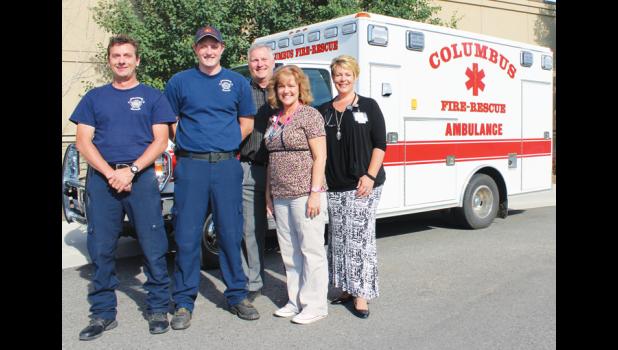
Countywide ambulance district a possibility
Talks are underway among county officials to find a way to continue funding advanced-life support ambulance service in Stillwater County – including possibly establishing a countywide ambulance district supported by a property assessment or mill levy.
Columbus Fire Rescue currently provides advanced life support (ALS) service as mutual aid across Stillwater County and even neighboring counties. ALS support may include monitoring vital signs, advanced drug therapy, cardiac monitoring, oxygen and IV therapy.
“In the past, advanced life support service had to come from Billings,” Columbus Fire Chief Rich Cowger said.
GRANT FUNDING
Cowger said four of his department’s six full-time ambulance workers are funded by a federal SAFER grant through December 2017. The current $343,000 two-year grant is the second one the department successfully applied for, he said.
Replacing that funding and maintaining the county’s ALS capability is a major driver for Cowger’s talks with the county commissioners about a countywide emergency medical services funding mechanism.
Columbus Fire Rescue Medical Director Dr. David Kane notes that Columbus and Stillwater County have been very fortunate to have ALS and paramedic services available.
“This level of service is not the norm for a town of our size,” he said. “These services have been extremely valuable in creating a higher level of prehospital care.”
ALS ambulance is a critical service for county residents, Kane said.
“I am positive that many lives have been saved and will continue to be saved in the future with ALS services,” he said. “I strongly believe that we would be foolish to lose these services. We fund many programs and service lines that are very worthwhile. However, I don’t know of others that will literally save your or your family member’s life.”
AMBULANCE FEES
Stillwater County has three independent ambulance jurisdictions – Columbus, Absarokee and Park City, Cowger said. He emphasized that there are no plans to merge ambulance departments under one director.
“They started out as all-volunteer, quasi-private entities with no government funding or oversight,” he said.
The ambulance service in Columbus was started long ago by the Jaycees and then merged with the city fire department in 2008.
“We were short-handed at the time,” he said. “It took about four years of negotiations to complete.”
One result of the merger was the first paid position – the chief. Today the department has six paid employees – three full-time paramedics and three full-time Advanced EMTs. The department also has about 50 volunteers, of which 35 will be certified EMTs by this fall, Cowger said.
“Both Park City and Absarokee only provide basic life support,” Cowger said. “And right now, there’s nothing on property owners’ tax bills for emergency medical services. Patients get billed for ambulance service.”
Ambulance fees mostly go to paying for expensive medical equipment, not staff, Cowger said.
“A cardiac monitor can cost $36,000, and a cot can cost from $6,000 to $12,000,” he said.
Cowger noted that the number of calls for ambulance service at Absarokee and Park City is not large enough to justify hiring ALS staff at those locations – they rely on mutual aid for many calls.
ALS RECOGINTION
The Park City Ambulance Department has four active volunteers and four more coming on board once they complete their EMT certification, according to Dorothy Alegria, the department’s director.
“We’re a private entity with no tax funding,” she said. “We rely on ambulance fees and donations.”
Alegria emphasized the importance of ALS support provided by Columbus.
“It helps with the long transport time from rural areas that mostly have basic life support service,” she said. “It’s important for providing quality patient care.”
Kane recognized the EMT volunteers in Columbus and Stillwater County for their dedication and training.
“The ambulance service could not exist without their immense commitment, time and skills,” he said. “They are the backbone of the service.”
Beyond that, paramedics raise the bar with the additional skills they’ve been trained for, Kane said, while the Stillwater Billings Clinic has developed a trauma receiving program, acute stroke protocol and acute STEMI or heart attack protocol based in large part on the ALS service currently available here and the initiation of treatment in the field that saves time and lives.
“The paramedic ALS service has enabled us to have timely transfers of our sickest patients to a higher level of care as needed,” he said. “Otherwise, we have to wait sometimes many hours for a crew out of Billings.”
BALLOT MEASURE
A ballpark figure for countywide EMS funding could be $200,000, Cowger said, with most of it going to funding the ALS staff at Columbus Fire Rescue and the rest going to the Absarokee and Park City ambulance departments. The details of how the funding mechanism would work are in the early talking stages – the revenue could come from an assessment on property or a mill levy.
“We would set up an interlocal agreement with Absarokee and Park City similar to the one between the city of Columbus and the Columbus Rural Fire District,” Cowger said.
Cowger said he’s been looking at other Montana counties to see how they handle EMS funding.
“EMS systems across Montana are in trouble,” Cowger said. “This is not unique to Stillwater County. Many ambulance services rely on volunteers, but as they get older they’re not being replaced.”
Cowger said he assumes any type of assessment or mill levy proposal will go to the voters for their approval.
“Funding EMS in Stillwater County will be critical,” Cowger said.