
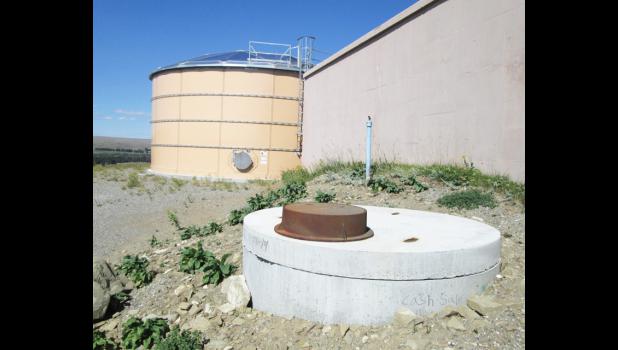
Absarokee water woes
Absarokee water users will get a chance to weigh in on several options for much needed upgrades to the community’s water system at a public meeting on Jan. 20 – including two that raise rates.
The options come from a draft preliminary engineering report prepared by Great West Engineering. Collette Anderson presented the report and took input at the Absarokee Sewer & Water District Board of Trustee’s Dec. 29 work session.
The report runs the gamut from water sources to storage to distribution, but the focus of the board is on reducing leaks, increasing pipe sizes to improve flow for fire hydrants, and addressing potential contamination caused by years of patching corroded steel pipes.
The district has averaged 70 percent water losses from leaks over the past three years. The Montana Department of Environmental Quality recommendation is 10-15 percent, Anderson told the board.
The options
Anderson’s report presents a 4-phase plan to improve the district’s distribution system. Included in the plans are a loop around the high school to improve fire flow, a new Rosebud Creek crossing about a quarter mile downstream from the bridge to keep the system connected in case of an emergency, and a larger main connecting the hillside tanks with the community below.
The board agreed to present three alternatives to the public on Jan. 20, with costs based on a Montana State Revolving Fund loan at 2.5 percent over 20 years and obtaining the maximum funding benefits – two state grants and an SRF loan “forgiveness” of $500,000. The alternatives include:
• Phase 1 only, using a $864,000 loan covered by the new $12 per month capital fund, so no monthly water rate increase.
• Phase 1 and 2 combined, using a $2.1 million loan that would raise water rates by 28 percent to an average of $48.71 per month.
• Phases 1-4, with all recommended improvements to the distribution system, using a $3.6 million loan that would raise water rates by 75 percent to an average of $66.56 per month.
District manager Steve Skuhra recommended that the board select phasing options that address the water mains with the worst leaks first.
Anderson said she based her phasing recommendations on replacing steel pipes first, then increasing fire flows and then cost, but she agreed to rearrange the phasing options as the board directs her before the Jan. 20 meeting.
During an Oct. 13 public meeting to present a new water rate proposal, Anderson explained that Absarokee had about 11,000 linear feet of deteriorating or undersized steel pipes. She noted that the town of Cascade recently replaced about 12,000 linear feet of water mains for about $1.5 million, much of which was paid through grants and low-cost loans.
Following the Oct. 13 meeting, the board approved a rate change that increased the base rate from $17 to $22 to address increased operating and maintenance costs and added a $12 fee for capital improvements. That brought the total monthly charge to $34 – the same as existed with the $17 fee in place for the new water tank, which is now paid off.
Public reaction
The district could accomplish all four phases over an 8-year period with an amended preliminary engineering report sometime in the future, Anderson told the board.
“There’s no guarantee the next board would approve that step,” board president Mike Reynolds noted.
The board was also concerned about how the public will react to the proposed plans.
Trustee Tom Degele pointed out that residents saw a new main installed during the Highway 78 project, and they see the new tank up on the hill, but water losses remain extremely high.
“We just finished paying off the new tank,” he said. “Proposing a rate hike would be putting up a red flag for a fight.”
Trustee Alan Rohde wanted to know what would happen if the district raises rates and spends millions of dollars replacing aging water mains, but then water losses continue to be high because of leaks in service lines between the curb stops and customers’ meters. A corroded service line to the Hawkins Park rest room that was replaced in May 2015 may have leaked about 2 million gallons per month. Property owners are responsible for service lines, but they can be expensive to replace, and customers’ meters don’t measure water losses in service lines, so it’s hard to know if a service line is leaking.
Rohde also noted that if the public is presented an option with no rate increase, like Phase 1 alone, that’s the one they’ll vote for.
“We’re at the mercy of those who show up at the meeting,” Reynolds said.
Trustee Roger Nummerdor had a suggestion for dealing with the “silent majority” who don’t attend meetings – make a video of the public presentation and post it on the district’s Facebook page. Anderson said such a video would also positively impact funding agencies.
Looking forward
The water district’s last preliminary engineering report was completed in 1998. The newest report looks 20 years ahead with an assumed population growth of 1 percent per year.
As an aside, Nummerdor noted that the community can’t grow until the county upgrades the sewer system and lifts the moratorium on new hook-ups.
Based on DEQ requirements for projected average water demand in 2035 and meeting fire suppression needs, Absarokee should have 640,000 gallons of storage capacity. It has 450,000.
Anderson’s report includes seven alternatives for additional storage capacity, ranging from $860,000 to repair the concrete tank on the hill and putting a new steel tank next to it, to $2.7 million for a 170-foot high elevated steel tank.
Current water supply from the district’s wells meets DEQ requirements for maximum demand, but it may not by 2035, Anderson said. On the other hand, reducing the huge water losses in the distribution system might affect both supply and storage needs, she noted.
Looking that far into the future raises questions about the local economy – will the cost of living be higher, will residents make more money, the board wanted to know.
“People should be aware that delaying things could cost them more in the end,” Rohde said.
Skuhra, however, noted that the large number of senior citizens in Absarokee might not recognize the benefits of projects with 20-year goals.
Based on the U.S. Department of Commerce’s median household income figure of $44,375 for Absarokee and the assumption that people pay 1.4 percent of their income for water, Absarokee water users should expect to pay $55.71 per month.
A community survey currently underway by the water district is trying to determine if the Commerce Department’s income figure is correct. So far the district has received 175 completed survey forms, water district secretary Lori Good said, and they indicate by a 2-1 margin that Absarokee households are below the Commerce Department figure.
The district needs a 67 percent return rate on the survey. If the district can prove Absarokee has a lower median household income, it can charge water users less than $55.71 per month while still qualifying for state grants and loan “forgiveness.”
The board will present the engineering report and the board’s preferred options during a public meeting at the Absarokee Sewer & Water District office, 9 North Montana Avenue, on Wednesday, Jan. 20, starting at 7 p.m.